Student Draft Review: Checking Claims Against Sources

Reviewing a draft is a manual process of matching text to evidence. You must verify that every claim traces back to a consulted source. This guide outlines how to check specific sentences for accuracy and clarity without promising a final grade or compliance status.
Check your draft in Neuroslop.
Verify Claims Against Consulted Notes
Start by isolating factual statements in your draft. For each one, locate the corresponding note or citation in your source material. If a sentence states a fact that is not present in your notes, remove it or mark it for further research. Do not assume that a plausible-sounding statement is correct. For example, if your draft says a study found a 50% increase, but your notes only mention a significant increase, you must correct the draft to match the specific data in your notes. This step ensures that your writing reflects only what you have actually read and verified. It is a necessary condition for academic honesty, not a guarantee of a high score. Treat this as a factual audit, not a stylistic preference.
The Australian Government Style Manual recommends simpler alternatives to longer expressions; treat this as writing guidance and preserve any specialist meaning the passage requires Australian Government Style Manual.
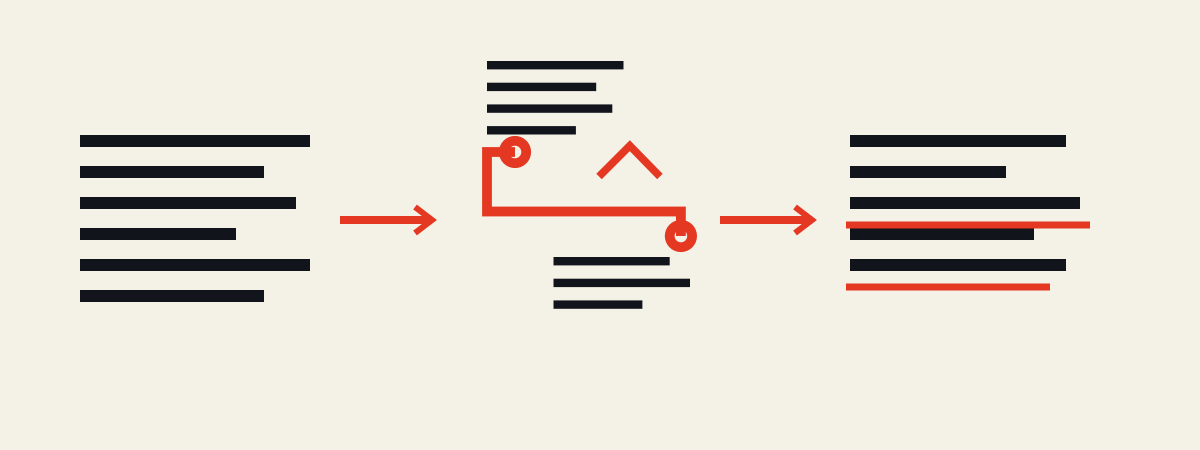
- Find the source
- Compare the claim
- Keep the conditions
A conceptual workflow, not measured results.
Refine Wording for Clarity
After verifying facts, focus on language. The Australian Government Style Manual recommends simpler alternatives to longer expressions; treat this as writing guidance and preserve any specialist meaning the passage requires. When editing, look for verbose phrases that obscure meaning. For instance, change "in the event that" to "if" unless the formal tone is specifically required by the assignment. However, do not simplify technical terms if the audience expects precision. The goal is to make the text easier to read without altering the intended meaning. This is an editorial choice, not a rule that applies to every discipline. Always prioritize the specific requirements of your assignment over general style advice.
The Canada.ca style guide recommends reading aloud or using a screen reader to find wording to clarify or shorten; this is a review technique, not a guarantee of clarity or rankings Canada.ca Content Style Guide.
Test Readability with Audio
A practical review technique is to listen to your text. The Canada.ca style guide recommends reading aloud or using a screen reader to find wording to clarify or shorten; this is a review technique, not a guarantee of clarity or rankings. Listening helps you catch awkward phrasing or run-on sentences that your eyes might skip. If a sentence is difficult to say out loud, it is likely difficult to read. You can also use this method to check the flow between paragraphs. This step is optional but useful for catching subtle errors. It does not replace manual proofreading for spelling or grammar. Use it as one part of a broader review process, not a standalone solution.
Sources
Try it yourself: check any text for AI with the free Neuroslop detector.